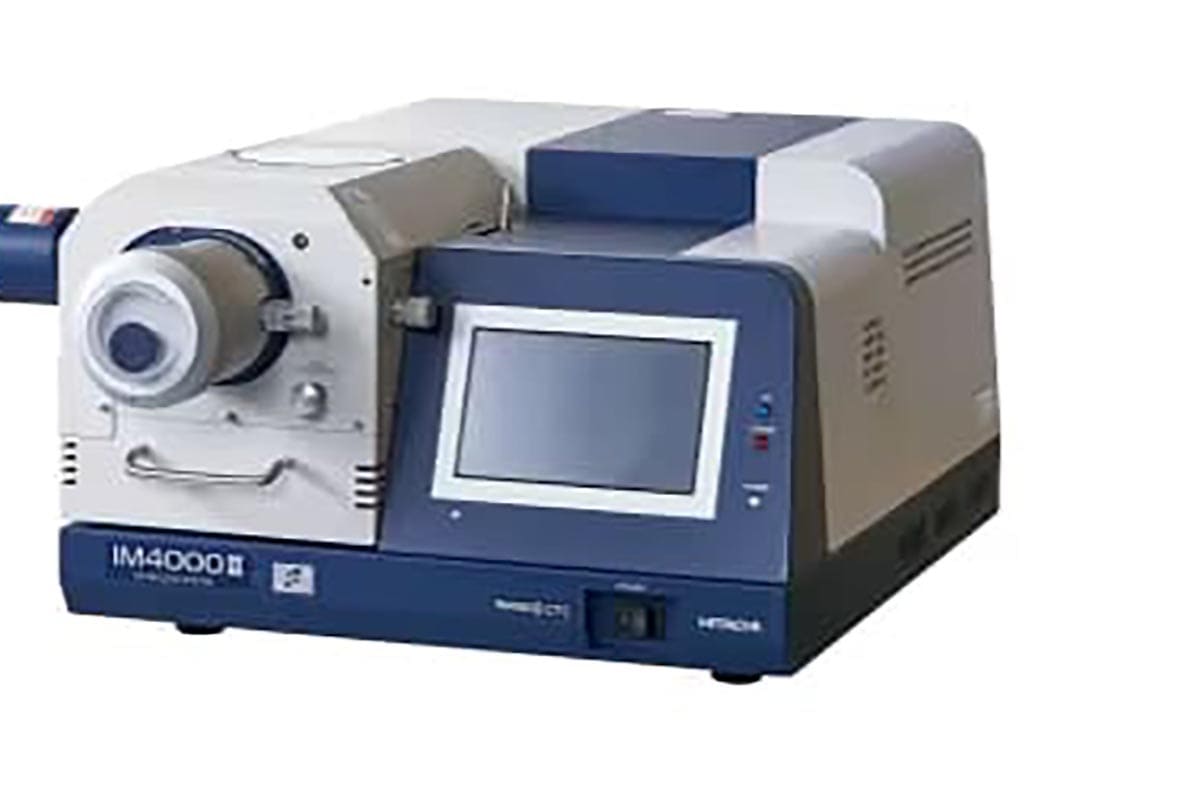
IM4000II supports both cross section milling and flat-milling to prepare specimens depending on the purpose. Cooling Temperature Control, Air Protection Holder Unit, and Various options enable preparation of various cross section specimens.
The cross section milling rate*1 of the IM4000II is 500 µm/h or greater. It is effective for hard materials that conventionally require extended processing.
When the swing angle during cross section milling changes, the corresponding processing width and depth change. The figure below shows the SEM images of a Si wafer after cross section milling. Processing conditions are the same as shown above except the swing angle has been reduced from ±30˚ to ±15˚. It is demonstrated that the processing depth is deeper than the above results and therefore very effective for rapid cross section preparation of specimens with a target structure far from the top surface.
Prepare a cross section specimen in a localized region of interest (ROI)
Prepare a cross section specimen that is difficult to polish by other methods (composite materials, multi-layer interface, papers/films, etc.)
Remove mechanical artifacts from the polishing process (maximum diameter of 50 mm x thickness of 25 mm)
Remove the surface or upper layers of multilayer film
Discriminate layers of the cross section for multilayer film (emphasizing irregularities)
Preprocess large areas for EBSD (reducing irregularities)
The cross section milling rate*1 of the IM4000II is 500 µm/h or greater. It is effective for hard materials that conventionally require extended processing.
When the swing angle during cross section milling changes, the corresponding processing width and depth change. The figure below shows the SEM images of a Si wafer after cross section milling. Processing conditions are the same as shown above except the swing angle has been reduced from ±30˚ to ±15˚. It is demonstrated that the processing depth is deeper than the above results and therefore very effective for rapid cross section preparation of specimens with a target structure far from the top surface.
Prepare a cross section specimen in a localized region of interest (ROI)
Prepare a cross section specimen that is difficult to polish by other methods (composite materials, multi-layer interface, papers/films, etc.)
Remove mechanical artifacts from the polishing process (maximum diameter of 50 mm x thickness of 25 mm)
Remove the surface or upper layers of multilayer film
Discriminate layers of the cross section for multilayer film (emphasizing irregularities)
Preprocess large areas for EBSD (reducing irregularities)
*1The maximum milling depth in one hour for Si protruding 100 μm from the maskedge.
*2Option to deliver with the main unit. Some functions may be restricted during the use of cooling temperature control.