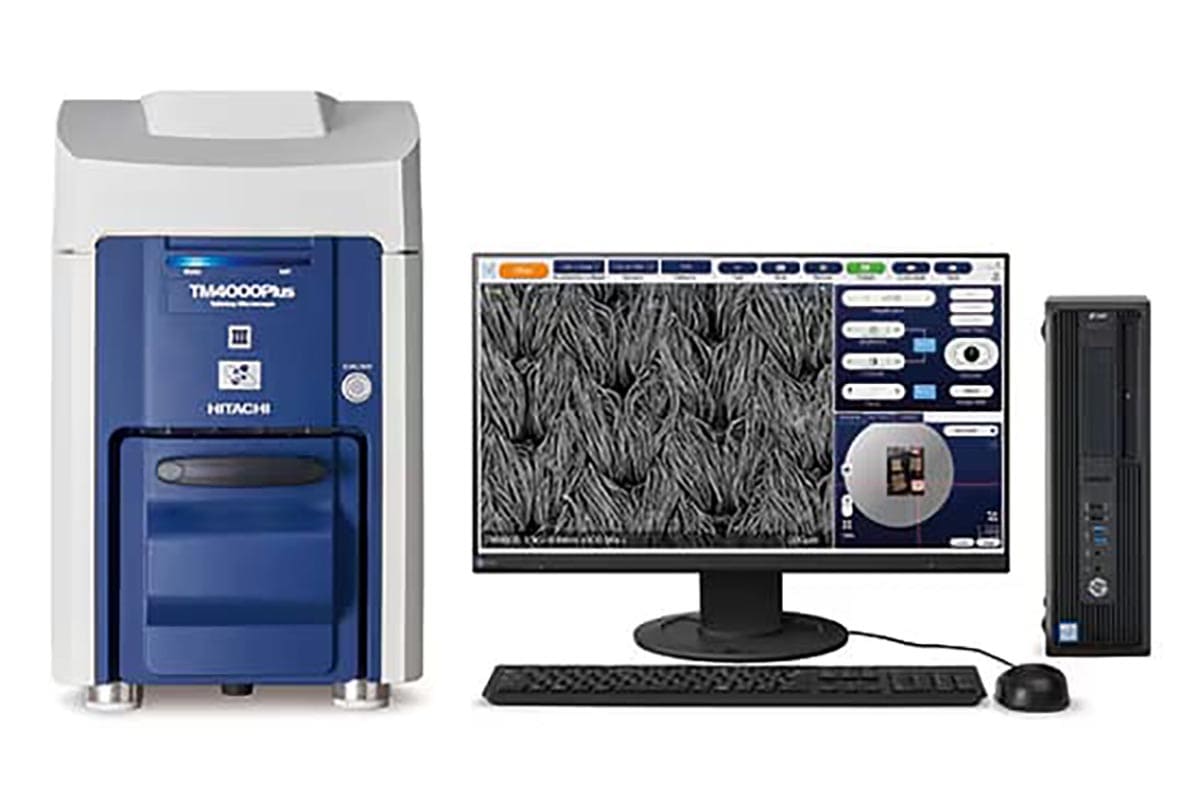
A tabletop microscope for the next generation of scientific leaders is now available The TM4000PlusIII/TM4000III is the newest addition to a lineup of microscopes that have sold over 5,800 units worldwide. Our newest updates bring improvements to users at the forefront of R&D, quality control, and education.
The TM4000PlusIII recipe function can be used to automatically execute operations, such as stage movement, magnification setting, and image capturing. Once the user builds a recipe, it can be executed to run the tool automatically with no further intervention. This significantly reduces the workload on operators and allows for more consistent results, even from inexperienced users.
Tasks such as purity analysis of industrial products and particle analysis of filters can be time consuming as data is required from many locations to complete the analysis. The TM4000PlusIII is equipped with a new high-current setting, Mode 5, which provides increased signal for imaging and EDS analysis. In combination with the Oxford Instruments EDS AZtecLiveLite particle analysis package, this helps to increase throughput.
SEM field-of-view navigation is performed using fast scanning modes, so images tend to be prone to noise. The high-current function allows for easy field-of-view navigation due to its high signal-to-noise (S/N) ratio. This takes the stress out of specimen navigation!
The TM4000PlusIII is equipped with a system that monitors the filament and displays graphics to show the remaining lifetime of the filament. If the equipment is being operated by multiple users, this makes it possible to plan the use of the tool in a systematic way. There is no more need to worry about the filament suddenly running out when the tool is most needed.
Users can try out electron microscopy with all kinds of specimens: picked flowers, treasured minerals or familiar foods, with no need for metal coating. The low-vacuum function of the TM4000PlusIII/TM4000III reduces preprocessing, and the high-sensitivity backscattered-electron detector (BSED) allows images to be obtained quickly.
Developing and maintaining digital skills is vital in today’s world. The automation support function allows you to experientially learn important programming concepts such as "sequential execution," "repetition," and "conditional branching" through the operation of the TM4000PlusIII.
*1Optional for TM4000PlusII only
*2Optional
The TM4000PlusIII recipe function can be used to automatically execute operations, such as stage movement, magnification setting, and image capturing. Once the user builds a recipe, it can be executed to run the tool automatically with no further intervention. This significantly reduces the workload on operators and allows for more consistent results, even from inexperienced users.
Tasks such as purity analysis of industrial products and particle analysis of filters can be time consuming as data is required from many locations to complete the analysis. The TM4000PlusIII is equipped with a new high-current setting, Mode 5, which provides increased signal for imaging and EDS analysis. In combination with the Oxford Instruments EDS AZtecLiveLite particle analysis package, this helps to increase throughput.
SEM field-of-view navigation is performed using fast scanning modes, so images tend to be prone to noise. The high-current function allows for easy field-of-view navigation due to its high signal-to-noise (S/N) ratio. This takes the stress out of specimen navigation!
The TM4000PlusIII is equipped with a system that monitors the filament and displays graphics to show the remaining lifetime of the filament. If the equipment is being operated by multiple users, this makes it possible to plan the use of the tool in a systematic way. There is no more need to worry about the filament suddenly running out when the tool is most needed.
Users can try out electron microscopy with all kinds of specimens: picked flowers, treasured minerals or familiar foods, with no need for metal coating. The low-vacuum function of the TM4000PlusIII/TM4000III reduces preprocessing, and the high-sensitivity backscattered-electron detector (BSED) allows images to be obtained quickly.
Developing and maintaining digital skills is vital in today’s world. The automation support function allows you to experientially learn important programming concepts such as "sequential execution," "repetition," and "conditional branching" through the operation of the TM4000PlusIII.
*1Optional for TM4000PlusII only
*2Optional
| Model name | TM4000Plus III | TM4000 III |
|---|---|---|
| Magnifications | 10× - 100,000× (Photographic magnification) 25× - 250,000× (monitor display magnification) | |
| Accelerating voltage | 5 kV, 10 kV, 15 kV, 20 kV | |
| Image signal | Backscattered electron Secondary electron Mix (Backscattered electron + Secondary electron) | Backscattered electron |
| Vacuum mode | Conductor: BSE Standard: BSE/SE/Mixed Charge-up reduction: BSE/SE/Mixed | Standard Charge-up reduction |
| Sample stage traverse | X: 40 mm, Y: 35 mm | |
| Maximum sample size | 80 mm (diameter), 50 mm (thickness) | |
| Electron gun | Pre-centered cartridge tungsten filament | |
| Signal detection system | High-Sensitivity 4-segment BSE detector High-Sensitivity Low-Vacuum SE detector (UVD) | High-Sensitivity 4-segment BSE detector |
| Evacuation system (vacuum pump) | Turbo molecular pump : 67 L/s×1 unit Diaphragm pump : 20 L/min×1 unit | |
| Stage | Motorized stage | Manual stage |
| Size / weight | Main unit330 (width)×614 (depth)× 547 (height) mm 55 kg | Main unit: 330 (width)×617 (depth)× 547 (height) mm 53 kg |
| Diaphragm pump: 144 (width)×270 (depth)×216 (height) mm, 5.5kg | ||