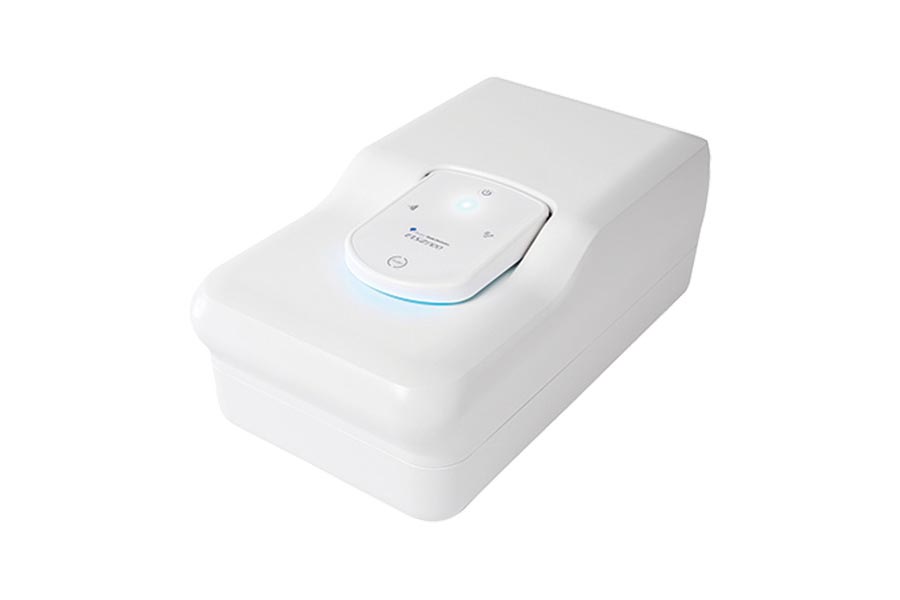
ELSZneo is the high-end model of the ELSZ series. This instrument measures zeta potential and particle size of both diluted and concentrated solutions, and molecular weight of a polymer. As new features, ELSZneo provides a multi-angle measurement to improve the separability of particle size distribution, particle concentration measurement, microrheology measurement, and gel network analysis. The zeta potential flat surface cell adopted a newly developed coating which enables measurement in a high salt concentration such as physiological saline. With the brand-new flat surface cell and ultra-micro volume cell that can measure particle size with a 3 μL of sample, ELSZneo is expanding the potential in the life science field.
Particle size and zeta potential measurement in a wide concentration range from diluted to concentrated solution (~ 40%)
Multi-angle measurement to carry out particle size distribution with higher separability
Zeta potential measurement of solid surface in high salt concentration
Particle concentration analysis using Static Light Scattering
Microrheology measurement using Dynamic Light Scattering
Gel network and gel heterogeneity analysis by measuring intensity of scattered light and diffusion coefficient of sample at multiple points
Standard flow cell which can be used for two types of measurement (Particle size and zeta potential) without replacing samples
Wide range of measurement temperature from0to 90℃
Temperature gradient function which enables denaturation (melting temperature) analysis for proteins
Electrophoretic mobility measurement and plot analysis for accurate zeta potential measurement
Band-pass filter (option)
Particle Size Distribution
Zeta Potential
Molecular Weight
Microrheology
Particle Concentration
Structural Analysis of Gel Networks
| Zeta Potential | No effective limitations | |||
| Mobility | -2×10 -5 ~ 2×10 -5 cm2/V・s | |||
| Particle Size | 0.6 nm ~ 10000 nm*1 (display range:0.1-106nm) | |||
| Molecular Weight | 340 ~ 2×10⁷ | |||
*1:Minimum value with histogram analysis : 0.2 nm
●Measure conditions
| Temperature | 0 ~ 90℃ | |||
| Concentration | Particle Size : 0.00001 % (0.1ppm) ~ 40 % *2 Zeta Potential : 0.001%~40% | |||
*2:(Latex112nm: 0.00001 ~ 10%、Taurocholic acid: ~ 40%)
Best suitable for basic and applied research of particle characterization in the field of surface chemical, inorganic, semiconductor, polymer, biotechnology, pharmaceutical and medical as well as surface research of film and flat state sample.
New functional material
Fuel cell(Carbon nanotube, Fullerene, Function film, Catalyst, Nano-metal)
Bionanotechnology ( Nano capsule, Dendrimer, Drug Delivery System(DDS)), Nanobubble
Biocompatible material
Ceramic and paints
Ceramic(Silica, Alumina, TiO2)
Surface modification, dispersion control of inorganic sol
Dispersibility, durability and shelf life control of ink, carbon black and organic pigment
Slurry state sample
Color filter
Flocculation research
Semiconductor
Alien objects research on silicon wafer
Interaction research of abrasive/additive on wafer surface
CMP slurry
Polymer and Chemical
Emulsion dispersion stability to extend product shelf life
Surface modification of latex
Function research of polyelectrolyte
Process control of paper production and Pulp additive research
Pharmaceutical and food
Emulsion dispersion stability to extend product shelf life
Dispersibility control of liposome and vesicle
Functionality of surfactant(Micelle)
Exosome,
Viruses, Virus-like particles(VLP)
Proteins
Particle size and zeta potential measurement in a wide concentration range from diluted to concentrated solution (~ 40%)
Multi-angle measurement to carry out particle size distribution with higher separability
Zeta potential measurement of solid surface in high salt concentration
Particle concentration analysis using Static Light Scattering
Microrheology measurement using Dynamic Light Scattering
Gel network and gel heterogeneity analysis by measuring intensity of scattered light and diffusion coefficient of sample at multiple points
Standard flow cell which can be used for two types of measurement (Particle size and zeta potential) without replacing samples
Wide range of measurement temperature from0to 90℃
Temperature gradient function which enables denaturation (melting temperature) analysis for proteins
Electrophoretic mobility measurement and plot analysis for accurate zeta potential measurement
Band-pass filter (option)
Particle Size Distribution
Zeta Potential
Molecular Weight
Microrheology
Particle Concentration
Structural Analysis of Gel Networks
| Zeta Potential | No effective limitations | |||
| Mobility | -2×10 -5 ~ 2×10 -5 cm2/V・s | |||
| Particle Size | 0.6 nm ~ 10000 nm*1 (display range:0.1-106nm) | |||
| Molecular Weight | 340 ~ 2×10⁷ | |||
*1:Minimum value with histogram analysis : 0.2 nm
●Measure conditions
| Temperature | 0 ~ 90℃ | |||
| Concentration | Particle Size : 0.00001 % (0.1ppm) ~ 40 % *2 Zeta Potential : 0.001%~40% | |||
*2:(Latex112nm: 0.00001 ~ 10%、Taurocholic acid: ~ 40%)
Best suitable for basic and applied research of particle characterization in the field of surface chemical, inorganic, semiconductor, polymer, biotechnology, pharmaceutical and medical as well as surface research of film and flat state sample.
New functional material
Fuel cell(Carbon nanotube, Fullerene, Function film, Catalyst, Nano-metal)
Bionanotechnology ( Nano capsule, Dendrimer, Drug Delivery System(DDS)), Nanobubble
Biocompatible material
Ceramic and paints
Ceramic(Silica, Alumina, TiO2)
Surface modification, dispersion control of inorganic sol
Dispersibility, durability and shelf life control of ink, carbon black and organic pigment
Slurry state sample
Color filter
Flocculation research
Semiconductor
Alien objects research on silicon wafer
Interaction research of abrasive/additive on wafer surface
CMP slurry
Polymer and Chemical
Emulsion dispersion stability to extend product shelf life
Surface modification of latex
Function research of polyelectrolyte
Process control of paper production and Pulp additive research
Pharmaceutical and food
Emulsion dispersion stability to extend product shelf life
Dispersibility control of liposome and vesicle
Functionality of surfactant(Micelle)
Exosome,
Viruses, Virus-like particles(VLP)
Proteins
Specification
| Principle | Particle size | Dynamic light scattering method | ||
| Zeta potential | Electrophoretic light scattering method (Laser doppler method) | |||
| Molecular weight | Static light scattering method | |||
| Optics | Particle size | Homodyne system | ||
| Zeta potential | Heterodyne system | |||
| Molecular weight | Homodyne system | |||
| Light source | Narrow-band laser diode | |||
| Detector | High sensitivity APD | |||
| Cell unit | Zeta potential/Particle size:Standard flow cell unit | |||
| Particle size:Particle size cell unit | ||||
| Particle size/Molecular weight : Particle size multi-angle cell unit | ||||
| Temperature | 0 ~ 90℃ (with gradient function) | |||
| Power requirements | AC 100 - 240V, 50/60Hz, 250VA | |||
| Size(WDH) | 330(W)×565(D)×245(H)mm | |||
| Weight | Approx. 22 kg | |||
| Standards | Particle size: ISO 22412:2017 / JIS Z 8828:2019 | |||
| Zeta potential: ISO 13099-2:2012/JIS Z 8836:2017 | ||||