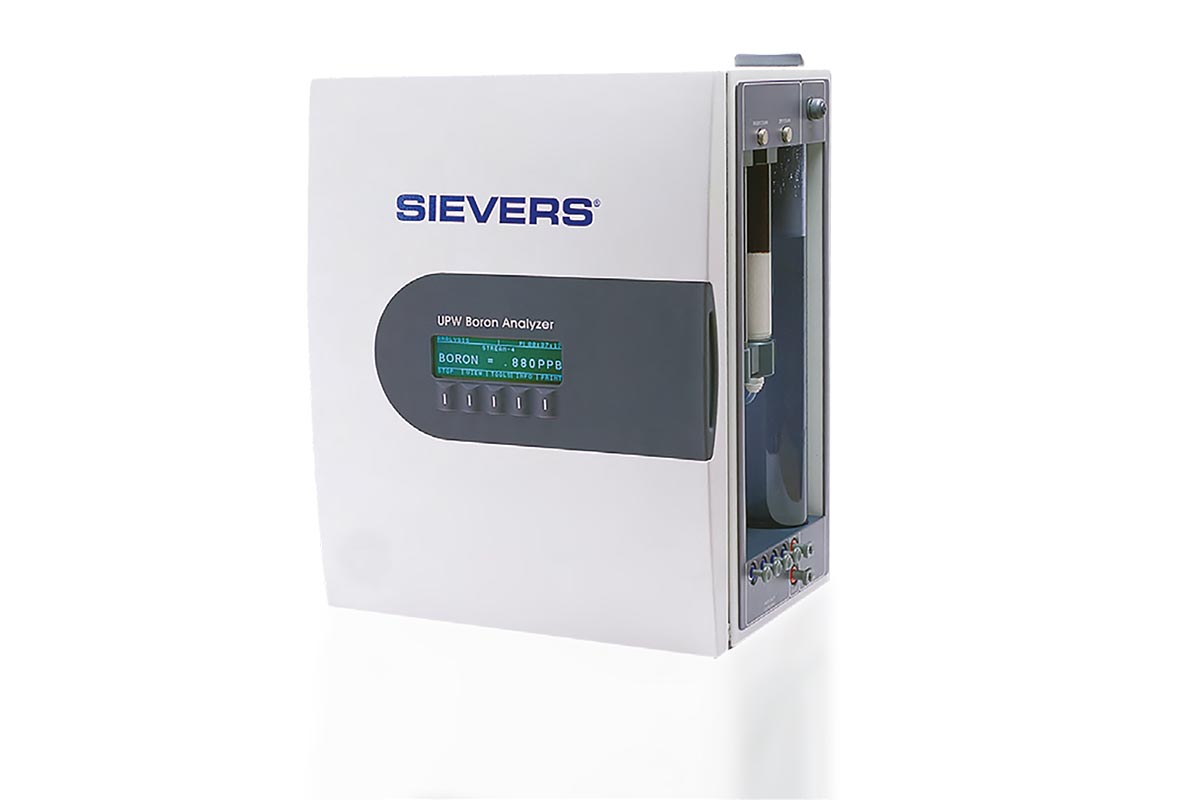
Continuous, online monitoring of boron down to single parts-per-trillion (ppt) levels As semiconductor chips shrink and become more complex, the demand for high-quality ultrapure water (UPW) is critical. Even the slightest contamination can cause significant defects, making early detection of impurities essential in microelectronics manufacturing. What’s at risk? Product yield, downstream processes, and unnecessary costs. The Sievers Boron Ultra Analyzer provides continuous, unattended online monitoring of boron concentrations in UPW processes with parts-per-trillion (ppt) sensitivity. This supports compliance with primary and polish loop specifications and enables manufacturers to optimize the timing of ion exchange (IX) resin bed regeneration. Boron monitoring is the most proactive IX process control strategy and is far superior than silica or ionic contamination monitoring.
The Sievers Boron Ultra Analyzer can significantly reduce operating expenses and maintain quality in UPW systems.
Boron Ultra detects an increase in boron prior to silica release, making it a critical tool to prevent the leakage of colloidal and ionic silica into ultrapure water. It is used to predict mixed-bed IX resin exhaustion, optimize electrodeionization (EDI) performance, and control primary and polish loop contamination levels.
Boron Ultra supports the International Roadmap for Devices and Systems (IRDS) 50 ppt boron limit in semiconductor UPW, supporting boron and silica contamination control.
The Sievers Boron Ultra was designed in cooperation with semiconductor manufacturers to meet the needs of facility managers, UPW system owners, and UPW process control engineers. Boron monitoring is the most proactive ion exchange process control strategy and is far superior than silica or ionic contamination monitoring.
Parts-per-trillion (ppt) sensitivity
20 data points per hour
Compliance with primary and polish loop specifications
Optimization of ion exchange resin regeneration
Silica and boron contamination control
Continuous, online monitoring down to single parts-per-trillion (ppt) boron
20 data points per hour
Compliance with primary and polish loop specifications
Meets all requirements for UKCA and CE marking
Multi-stream options – available in One-Stream and Two-Stream
Modern, intuitive GUI with multi-color LED backlit, 10.1” touchscreen display
Extensive suite of outputs – two isolated 4–20 mA analog outputs; two alarm outputs; two isolated binary outputs; two USB 2.0 ports; and one Gigabit Ethernet port
Minimal maintenance and consumables
Contamination control
Compliance
Optimization of resin regeneration
Process control
The Sievers Boron Ultra Analyzer can significantly reduce operating expenses and maintain quality in UPW systems.
Boron Ultra detects an increase in boron prior to silica release, making it a critical tool to prevent the leakage of colloidal and ionic silica into ultrapure water. It is used to predict mixed-bed IX resin exhaustion, optimize electrodeionization (EDI) performance, and control primary and polish loop contamination levels.
Boron Ultra supports the International Roadmap for Devices and Systems (IRDS) 50 ppt boron limit in semiconductor UPW, supporting boron and silica contamination control.
The Sievers Boron Ultra was designed in cooperation with semiconductor manufacturers to meet the needs of facility managers, UPW system owners, and UPW process control engineers. Boron monitoring is the most proactive ion exchange process control strategy and is far superior than silica or ionic contamination monitoring.
Parts-per-trillion (ppt) sensitivity
20 data points per hour
Compliance with primary and polish loop specifications
Optimization of ion exchange resin regeneration
Silica and boron contamination control
Continuous, online monitoring down to single parts-per-trillion (ppt) boron
20 data points per hour
Compliance with primary and polish loop specifications
Meets all requirements for UKCA and CE marking
Multi-stream options – available in One-Stream and Two-Stream
Modern, intuitive GUI with multi-color LED backlit, 10.1” touchscreen display
Extensive suite of outputs – two isolated 4–20 mA analog outputs; two alarm outputs; two isolated binary outputs; two USB 2.0 ports; and one Gigabit Ethernet port
Minimal maintenance and consumables
Contamination control
Compliance
Optimization of resin regeneration
Process control
Operating Specifications | ||
|---|---|---|
| Range | 0.010 - 100 ppb B | |
| Limit of Quantification (LOQ) | 0.030 ppb B | |
| Limit of Detection (LOD) | 0.010 ppb B | |
| Accuracy | ± 0.01 ppb B, <0.03 ppb B | |
| Precision | SD ≤ 0.003 ppb B, ≤ 0.100 ppb B RSD ≤ 3%, > 0.100 ppb B | |
| Minimum Sample Resistivity | 15 MΩ–cm | |
| Sample Temperature | 15°-40°C (59-104°F) | |
| Sample Flow Rate | 50-400 mL/min | |
| Sample Pressure | 103-689 kPa (15-100 psig) | |
| Calibration Stability | Typically 12 months | |
| Sample Particulates | 15-micron pre-filtration | |
| Waste | Gravity drain (no back pressure), vented | |
| Analysis Modes | Online, Averaged, and Online Timed | |
| Analysis Time1 | 3 minutes or 6 minutes | |
Analyzer Specifications | ||
| Power Requirements | 100-240 VAC, 40 W, 50/60 Hz | |
| Safety Certifications | CE, UKCA, ETL listed. Conforms to UL Std. 61010-1. Certified to CSA 22.2 No. 61010-1. | |
| Display | LED Backlit, 10.1-inch, 1280 x 800 Display with touchscreen | |
| IP Rating | IP 45 | |
| Inputs | 3 isolated Binary inputs | |
| Outputs | 2 isolated 4-20 mA Analog Outputs; 2 Alarm outputs; 2 isolated Binary Outputs; 2 USB 2.0 Ports (one external, one internal); 1 Gigabit Ethernet Port; | |
| Communication Protocols | Modbus TCP/IP | |
| Transient Overvoltage | Installation (Overvoltage) Category II (Instrument Environment Pollution Degree 2 assumed for purposes of testing and judging insulation integrity) | |
| Dimensions | 54.2 H x 59.3 W x38.8 D cm (21.35 H x 23.35 W x 15.27 D in) | |
| Weight | Empty: 21.75kg (48 lb); With Consumables: 23.1 kg (51 lb) | |
| Minimum Clearances (for temperature, humidity control, and access) | Front: 48.3 cm (19 in); Rear 2.5cm (1 in); Sides:30.5 cm (12 in) each side; Top: 30.5 cm (12 in); Bottom: Analyzer stands provide desktop clearance. | |
| Available Configurations | One-Stream or Two-Stream (Optional) | |
| Ambient Temperature | 10-40°C (50-104 °F) | |
| Altitude | Designed for use at altitudes up to 2000 m (6561 ft.) | |
| Maximum Relative Humidity | Up to 95%, non-condensing | |
Consumables | ||
| Boron Reagent | 45 days at 3-minute sampling rate; 90 days at 6-minute sampling rate | |
| Reagent Column | 12 months | |
| Zero Column | 12 months | |
| Peristaltic Pump Head | 12 months | |