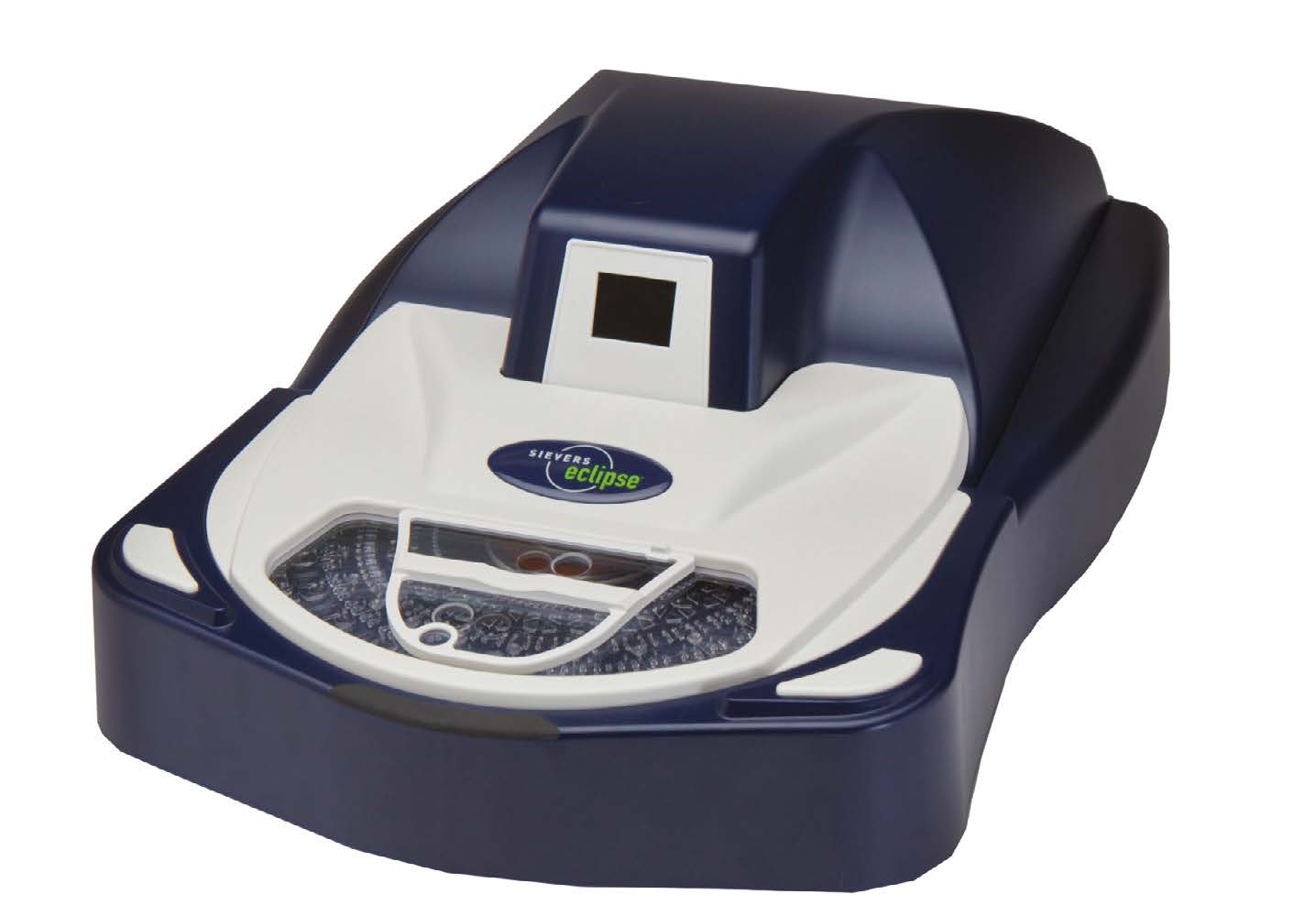
Breakthrough BET technology that delivers automation and compliance The innovative Sievers Eclipse automated endotoxin detection platform decreases assay setup time by up to 85% and reduces Limulus Amebocyte Lysate (LAL) reagent use by up to 90% while meeting all requirements of the harmonized pharmacopeia: USP <85>, EP 2.6.14 and JP 4.01. Through groundbreaking technology, the Eclipse endotoxin testing solution significantly decreases pipetting steps, reduces operator-to-operator variability, and simplifies BET test setup. The Eclipse platform leverages precise microfluidic liquid handling and embedded endotoxin to automate kinetic chromogenic assays. Throughput of 21 samples per plate is maintained without the complexity of robotics or the time and technique demands of a traditional LAL test.
At Veolia, We believe in making complex measurements simple.
For years, endotoxin testing has required well-trained technicians to carefully prepare samples and standards for gel clot and 96-well plate-based assays. These analytical approaches are slow to prepare, prone to error and retests, and don’t meet the latest data integrity guidelines. While these methods benefit from the sensitivity and specificity of Limulus amebocyte lysate (LAL) for the detection of endotoxins, there is a desire to decrease the use of LAL reagents. This is because LAL is created from the blood of horseshoe crabs, and we all want to conserve and optimize the use of this resource as much as possible.
Now, there’s an easier way to achieve compliant endotoxin testing and improve sustainability with a new compendial endotoxin assay using microfluidics. It simplifies test setup, decreases retest rates, fully complies with the latest data integrity guidelines, and reduces LAL usage by up to 90%.
Despite the need for easier, automated, and more sustainable solutions for endotoxin testing, many platforms fall short of meeting key requirements or streamlining installation and validation for easy adoption. With the Sievers Eclipse, you get the benefits of significantly easier BET assay setup and full compliance, without the complexity of robotics or difficult implementation.
The Sievers Eclipse BET Platform and enterprise software provide:
9-minute setup for 21-sample assay (time-savings of up to 85%)
Reduction in LAL reagent by up to 90%
Compliance with all requirements of the harmonized pharmacopeia: USP <85>, EP 2.6.14 and JP 4.01
Highly customizable software with full compliance with 21 CFR Part 11 and ALCOA+
| Testing Requirements | Sievers Eclipse BET Platform |
|---|---|
| Requirements of USP <85>, EP 2.6.14, and JP 4.01 | ✔️ |
| Samples and PPCs in at least duplicate | ✔️ |
| Minimum 3-point standard curve in at least duplicate using standardized endotoxin (RSE/CSE) | ✔️ |
| Negative controls in at least duplicate | ✔️ |
| Analyst and lysate lot qualification in at least triplicate | ✔️ |
| Use of FDA licensed LAL | ✔️ |
| Compliance with 21 CFR Part 11 and data integrity guidelines | ✔️ |
At Veolia, We believe in making complex measurements simple.
For years, endotoxin testing has required well-trained technicians to carefully prepare samples and standards for gel clot and 96-well plate-based assays. These analytical approaches are slow to prepare, prone to error and retests, and don’t meet the latest data integrity guidelines. While these methods benefit from the sensitivity and specificity of Limulus amebocyte lysate (LAL) for the detection of endotoxins, there is a desire to decrease the use of LAL reagents. This is because LAL is created from the blood of horseshoe crabs, and we all want to conserve and optimize the use of this resource as much as possible.
Now, there’s an easier way to achieve compliant endotoxin testing and improve sustainability with a new compendial endotoxin assay using microfluidics. It simplifies test setup, decreases retest rates, fully complies with the latest data integrity guidelines, and reduces LAL usage by up to 90%.
Despite the need for easier, automated, and more sustainable solutions for endotoxin testing, many platforms fall short of meeting key requirements or streamlining installation and validation for easy adoption. With the Sievers Eclipse, you get the benefits of significantly easier BET assay setup and full compliance, without the complexity of robotics or difficult implementation.
The Sievers Eclipse BET Platform and enterprise software provide:
9-minute setup for 21-sample assay (time-savings of up to 85%)
Reduction in LAL reagent by up to 90%
Compliance with all requirements of the harmonized pharmacopeia: USP <85>, EP 2.6.14 and JP 4.01
Highly customizable software with full compliance with 21 CFR Part 11 and ALCOA+
| Testing Requirements | Sievers Eclipse BET Platform |
|---|---|
| Requirements of USP <85>, EP 2.6.14, and JP 4.01 | ✔️ |
| Samples and PPCs in at least duplicate | ✔️ |
| Minimum 3-point standard curve in at least duplicate using standardized endotoxin (RSE/CSE) | ✔️ |
| Negative controls in at least duplicate | ✔️ |
| Analyst and lysate lot qualification in at least triplicate | ✔️ |
| Use of FDA licensed LAL | ✔️ |
| Compliance with 21 CFR Part 11 and data integrity guidelines | ✔️ |
System Specifications | |
|---|---|
BET Method | Kinetic chromogenic |
Detection Mode | Absorbance |
Range | 0.005–50 EU/mL |
Precision | ≤ 15% CV onset time |
Accuracy | 50–200% of actual |
Sample Type | Aqueous, injected by pipette |
Calibration | Up to 12 months |
Analysis Time | Up to 2 hours |
Sample Temperature | 37 ± 1 °C |
Ambient Temperature | 17–30 °C |
Capacity | Up to 21 samples in duplicate with positive product controls |
Temperature Control | 37 ± 0.5 °C |
Light Source | LED emitter |
Fluidic Failure Detection | 1450 nm emitter |
Optical Accuracy | ≤ 5% deviation from expected value |
Optical Linearity | R-Value ≥ 0.980 |
Optical Wavelength Filter | 405 nm |
Read Interval | 5 Seconds |
Analyzer Specifications | |
Outputs | Digital via USB |
Display | OLED |
Power Requirement | 100–240 Volts AC @50/60 Hz |
Fuses | T 8 A 250 VAC Fuse, size 5 x 20 mm. ONLY Littelfuse 218008 or Cooper Bussmann S506-8-R. |
Dimensions | H: 17.5 cm (6.9 in); W: 35.1 cm (13.8 in); D: 50.3 cm (19.8 in) |
Weight | 10 kg (22.1 lbs) |
Safety Certifications | UL 61010-1:2012Ed.3+R:20Apr2016 CSA C22.2#61010-2-020 CSA C22.2#61010-1-12:2012Ed.3+U1;U2 IEC 61010-1:2010 Ed.3+C1;C2 UL 61010-2-010:2015Ed.3 IEC 61010-2-010:2003Ed.2 UL 61010-2-020:2016Ed.3 IEC 61010-2-020:2016Ed.3 CSA C22.2#61010-2-010:2015Ed.3 |
Maximum Relative Humidity | 85% non-condensing |
Maximum Altitude | 3,000 m (9,800 ft) |
Pollution Degree | 2 |
Options & Accessories
Analyzer: Absorbance analyzer with consistent incubation control at 37 °C, centrifugal technology, and secure data transmission.
Microplate: Precise liquid handling device that achieves automation through innovative microfluidic technology with embedded endotoxin standards and PPCs.
Software: Highly customizable enterprise solution with 21 CFR Part 11 and ALCOA+ Data Integrity compliance features.
The Eclipse microplate, in conjunction with the Eclipse analyzer and software, uses centrifugal force and pneumatic chambers to measure and evenly distribute precise amounts of LAL reagent water, samples, and LAL across 104 optical wells. The optical wells comprise segments for standards curves, samples, and positive product controls (PPCs). The reaction is controlled at 37 +/-1 C, and a high definition view of each well is obtained through a reading at 405 nm every five seconds.