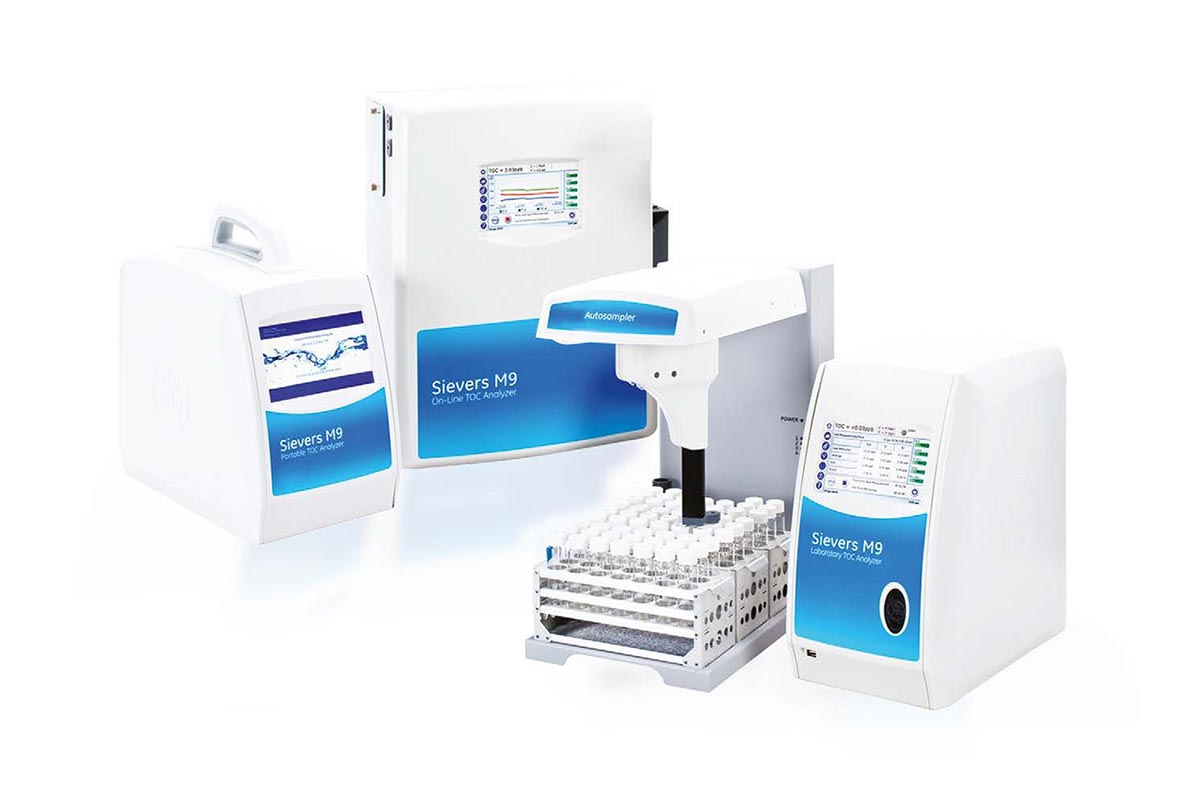
Explore how to increase efficiency and maintain compliance with the M9 Lab Tools that boost productivity are essential in today’s laboratories. Whether you use the M9 Lab for UPW monitoring, cleaning validation, or other applications, you can be certain the Sievers M9 is engineered for accuracy, compliance, and to increase efficiency through its unique features. Sievers M9 TOC Analyzers meet global regulatory requirements in the pharmaceutical industry, including USP <643> and <645>, EP 2.2.44 Total Organic Carbon, IP 2.4.30, CP Appendix VIII R, and JP16 2.59 monographs for Purified Water and Water for Injection.
M9 Lab Features & Benefits
Two-minute sample analysis time
Measures discrete grab samples or can be connected to the Sievers Autosampler for high-volume sample analysis
Automated operations, such as calibration, verification, and data analysis
Autoreagent feature automatically establishes optimal flow rates for each sample
Well suited for a variety of sample matrices and concentrations
Minimal preventive maintenance (typically just a few hours per year)
12-month calibration stability
Optional Stage 1 conductivity capability for simultaneous testing of and conductivity
Optional Turbo mode for four-second analysis
M9 Lab Features & Benefits
Two-minute sample analysis time
Measures discrete grab samples or can be connected to the Sievers Autosampler for high-volume sample analysis
Automated operations, such as calibration, verification, and data analysis
Autoreagent feature automatically establishes optimal flow rates for each sample
Well suited for a variety of sample matrices and concentrations
Minimal preventive maintenance (typically just a few hours per year)
12-month calibration stability
Optional Stage 1 conductivity capability for simultaneous testing of and conductivity
Optional Turbo mode for four-second analysis
Operating Specifications* | |
|---|---|
| Range | 0.03 ppb to 50 ppm |
| Precision | < 1% RSD |
| Accuracy | ± 2% or ± 0.5 ppb, whichever is greater |
| Display Readout | 3 significant digits |
| Sample Type | Autosampler or discrete grab sample |
| Calibration | Typically stable for 12 months |
| Analysis Time | 2 minutes (4 seconds with the optional Turbo mode) |
| Sample Temperature | 5–95 °C (41–203 °F) |
| Ambient Temperature | 5–40 °C (41–104 °F) |
| Instrument Sample Flow Rate | 0.5 mL/min |
Analyzer Specifications | |
| Outputs | USB device port (1); USB host ports (3); Modbus TCP/IP |
| Display | 7" WVGA 800X480 pixel, Color LCD with touch-screen |
| Power | 100 - 240 V~, 50 -60 Hz, 100 VA |
| Fuses | Replace with same type and size fuse: T 1.6 A 250 VAC Fuse (Slow Blow), size 5 X 20 mm appliance inlet |
| Dimensions | H: 42.2 cm (16.6 in); W: 24.6 cm (9.7 in); D: 40.0 cm (15.8 in) |
| Weight | 9.4 kg (20.6 lb) |
| Safety Certifications | ETL, CE (see Declaration of Conformity) |
Sample Conductivity (Optional) | |
| Raw Conductivity Range | 0.01 to 2,000 μS/cm |
| Conductivity Accuracy | ±0.005 μS/cm or ±1%.whichever is greater |
| Precision | <0.25% RSD |
Environment | |
| Maximum Relative Humidity | 0 - 95%, non-condensing |
| Maximum Altitude | 3,000 m (9.800 ft) |
| Pollution Degree | 2 |
 The UV lamp inside this product contains mercury and must be recycled or disposed of in accordance with local, state, and federal laws. The UV lamp inside this product contains mercury and must be recycled or disposed of in accordance with local, state, and federal laws. | |
| * Stated analytical performance is achievable under controlled laboratory conditions that minimize operator and standards errors. | |